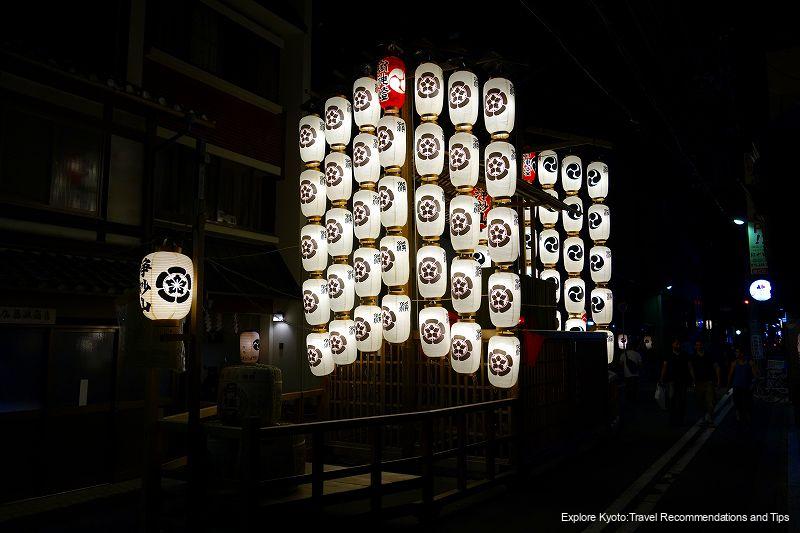
Following the Saki Matsuri, the Yoiyama of the Gion Matsuri Ato Matsuri, revived for the first time in 49 years, has begun.
During the Gion Matsuri Ato Matsuri, traffic regulations on Shijo Street and Karasuma Street have changed, and the pedestrian paradise during the Yoiyama period has been eliminated. Additionally, there are no street stalls.
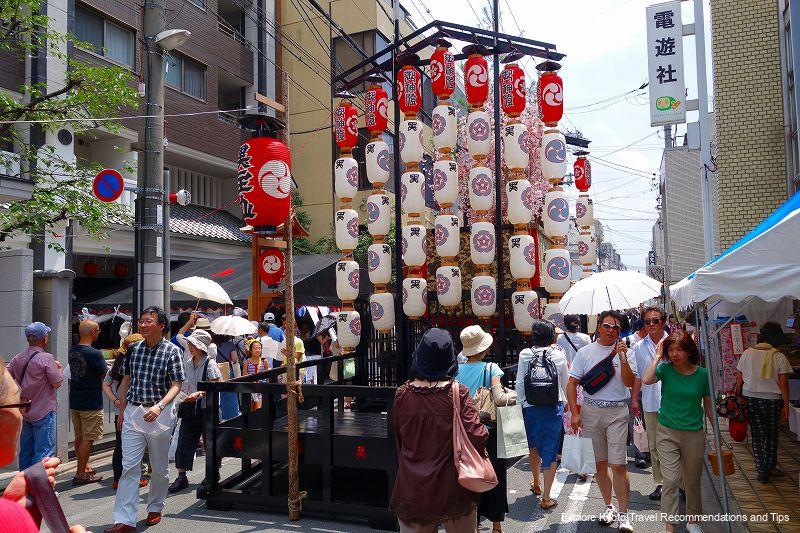
Since the 21st was a public holiday with favorable weather, there was a significant crowd during the day. The area around Ofune-hoko was particularly crowded.
- Gion Matsuri: Ato Matsuri Revived After 49 Years
- Gion Matsuri Ato Matsuri Ofune-hoko
- Gion Matsuri Ato Matsuri En no gyoja-yama
- Gion Matsuri Ato Matsuri: Kuronushi-yama
- Gion Matsuri Ato Matsuri: Kita Kannon-yama
- The decorations and hangings of Kita Kannon-yama
- Gion Matsuri Ato Matsuri: Minami Kannon-yama
- Gion Matsuri Ato Matsuri: First Night of Yoiyama
Gion Matsuri: Ato Matsuri Revived After 49 Years
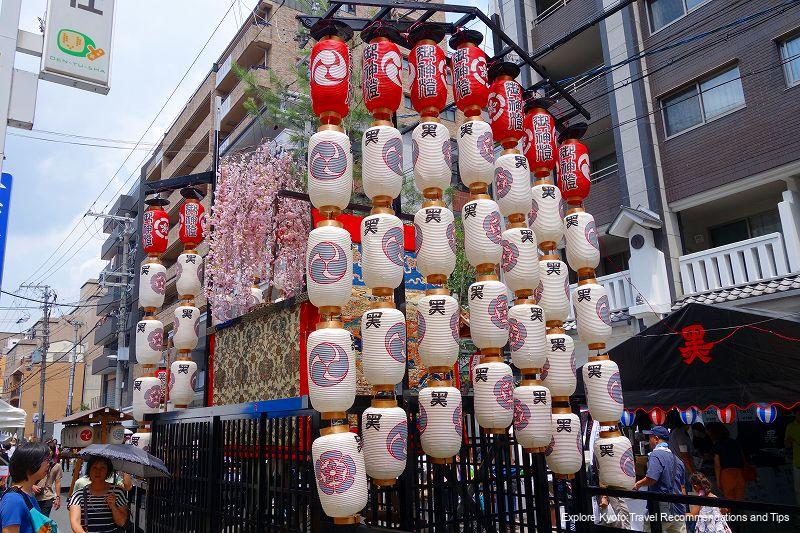
In 2014, the Gion Matsuri underwent significant changes. The Saki Matsuri and Ato Matsuri, which had been separated for 49 years, were revived, resulting in two rounds of Yoiyama and float parades.
Of the 33 festival floats, 10 participate in the Ato Matsuri. The Ato Matsuri Yoiyama is held from July 21st to 23rd, and the float parade takes place on July 24th.
During the Gion Matsuri Ato Matsuri, traffic regulations on Shijo Street and Karasuma Street are changed, and the pedestrian zones during the Yoiyama period are eliminated. Additionally, there are no street stalls.
Another significant highlight is the revival of the Ofune-hoko after 150 years, which serves as the grand finale of the Gion Matsuri Ato Matsuri float parade.
Gion Matsuri Ato Matsuri Ofune-hoko
First, let’s start with the main attraction of the Ato Matsuri, the Ofune-hoko, which has been revived after 150 years.
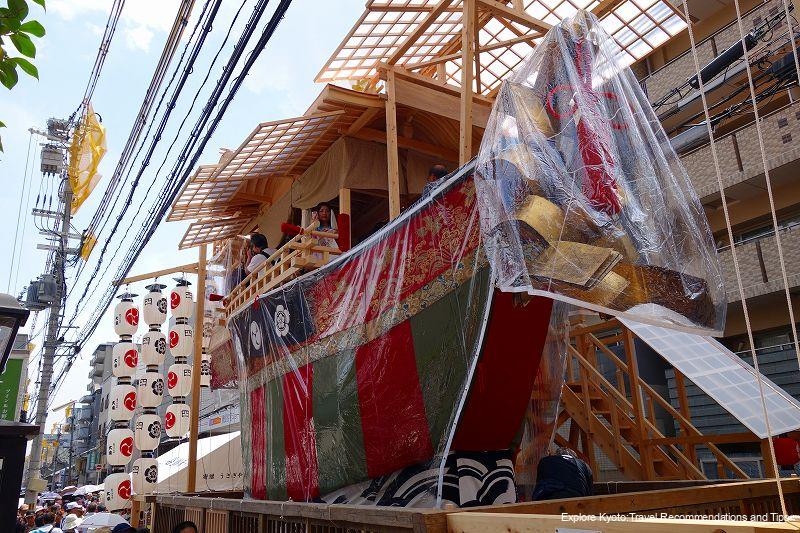
The Ofune-hoko originally derives from the Nihon Shoki, specifically the story of Empress Jingu’s departure for Silla.
The Ofune-hoko, known as the “Triumphant Return Float,” was paired with the Fune-hoko, the “Departure Float.” Previously, they paraded separately during the Saki Matsuri and Ato Matsuri.

The Ofune-hoko is said to have existed before the Onin War (1467) but was mostly destroyed in the Hamaguri Rebellion of 1864. Since then, it had remained dormant.
The Hamaguri Rebellion was a conflict between the Choshu Domain and the Tokugawa Shogunate in the late Edo period, during which about 30,000 houses in Kyoto were burned. It’s hard to believe such turmoil occurred in Kyoto.
The Ofune-hoko is located in present-day Shijo-cho, slightly north of the Fune-hoko.
When there were two floats, the area was divided into North Shijo-cho and South Shijo-cho, with each taking turns to parade annually.
At that time, Shinmachi Street was lined with wealthy merchants and samurai residences, making Shijo-cho a prosperous area.
Despite it being the first day of the Yoiyama, the Ofune-hoko chimaki (protective charms) sold out quickly.
This is the line to board the Ofune-hoko. The wait can be several minutes, but boarding the Ofunehoko, a triumphant ship, might bring good fortune.
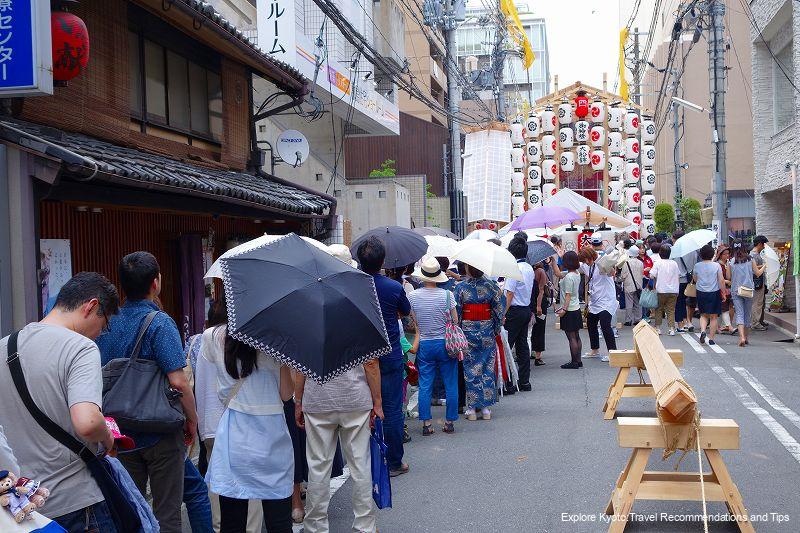
Since the Ofune-hoko is newly restored, the wooden structure and lantern stands have a faint scent of cypress. This structure will be used for hundreds of years to come.
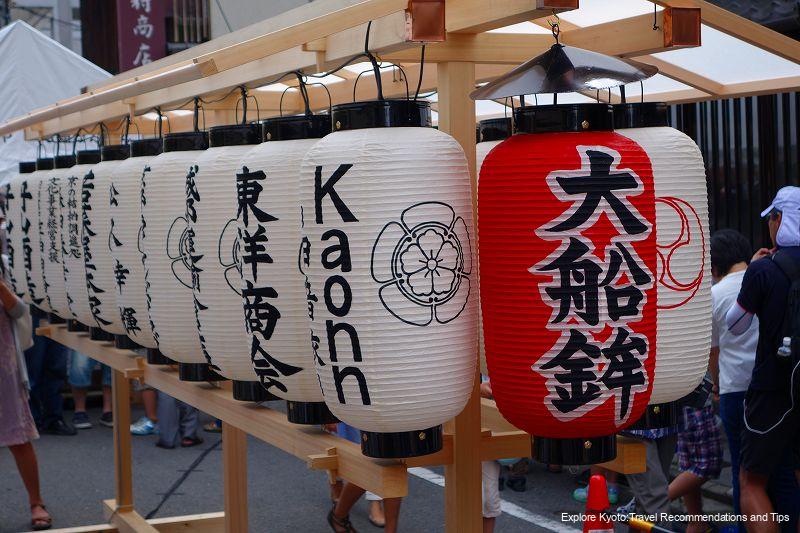
Like the Fune-hoko, the Ofune-hoko enshrines Empress Jingu, along with auxiliary deities Sumiyoshi Myojin, the steersman Kashima Myojin, the navigator Ryujin, and Azumi Isonokami, who are also enshrined on the Fune-hoko.
Empress Jingu on the Fune-hoko is depicted in armor ready for battle, while on the Ofune-hoko, she is depicted in a hunting garment, having returned victorious from the war.
After her triumphant return from the Korean Peninsula, Empress Jingu safely gave birth to a prince, which led to her being revered as a deity of safe childbirth. Protective charms for safe childbirth, initially found on the Fune-hoko, are also available on the Ofune-hoko.
Pregnant women can also be seen around the Ofune-hoko.
Gion Matsuri Ato Matsuri En no gyoja-yama
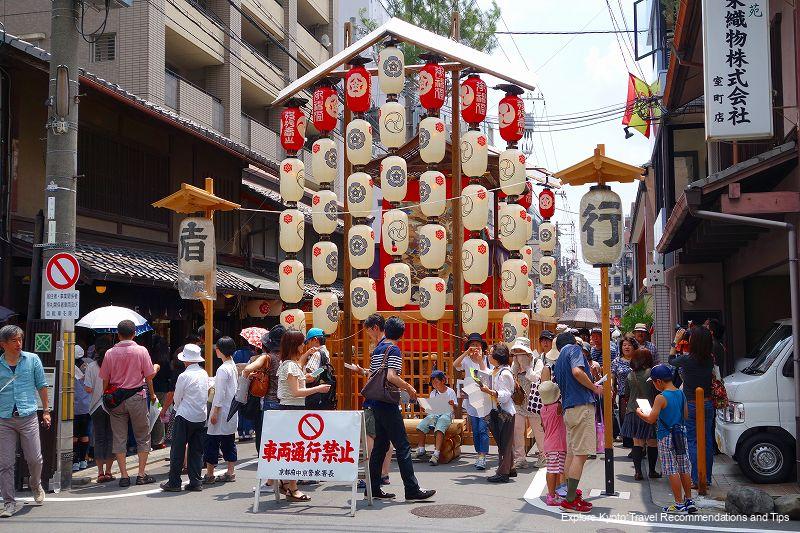
En no gyoja-yama at Anekoji Muromachi has existed since before the Onin War. It is a kakiyama (shoulder-carried float).
The floats of the Gion Matsuri are categorized into hoko, yama, kakiyama, and kasa-hoko. While hoko and yama have wheels and are pulled, kakiyama are carried on shoulders.
On the first night of Yoiyama, the sacred objects are still resting. On the day of the parade, En no Gyoja, Hitokotonushi-no-Kami, and Katsuragi-no-Kami are enshrined.
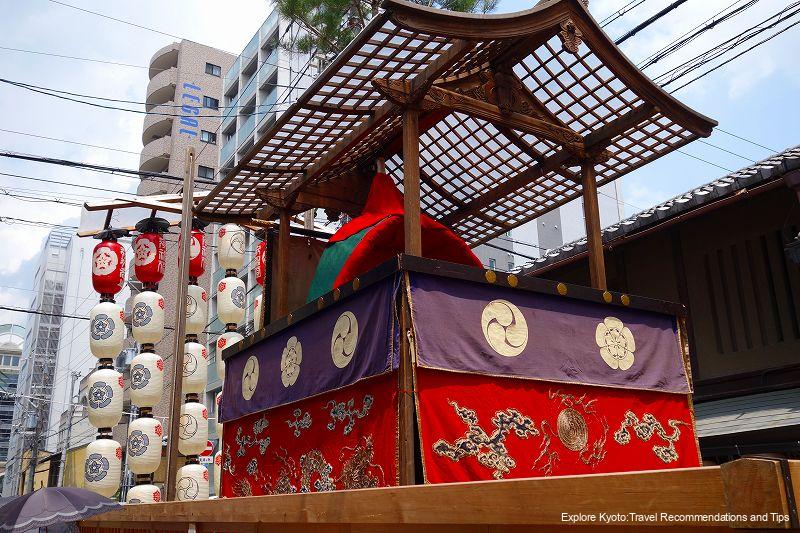
The name En no gyoja-yama comes from the legend of En no Gyoja, the founder of Shugendo, who, along with Hitokotonushi-no-Kami and Katsuragi-no-Kami, built a bridge between Mt. Katsuragi and Mt. Omine.
Following this legend, En no gyoja-yama enshrines three deities: En no Gyoja, Hitokotonushi-no-Kami, and Katsuragi-no-Kami.
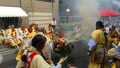
During the Yoiyama, Yamabushi from the Honzan Shugendo Shogoin perform the Goma Burning ceremony in front of En no gyoja-yama, honoring En no Gyoja, the founder of Shugendo.
Gion Matsuri Ato Matsuri: Kuronushi-yama
Muromachi Sanjo Shimoru, Kuroshiyama. This float is named after the noh play “Shiga,” which depicts Otomo no Kuronushi gazing at cherry blossoms.
Otomo no Kuronushi was a Heian period poet based in Shiga County, Omi Province. He is one of the Six Poetic Geniuses, whose poems are included in collections such as the “Kokin Wakashu” and “Shuishu Wakashu.”
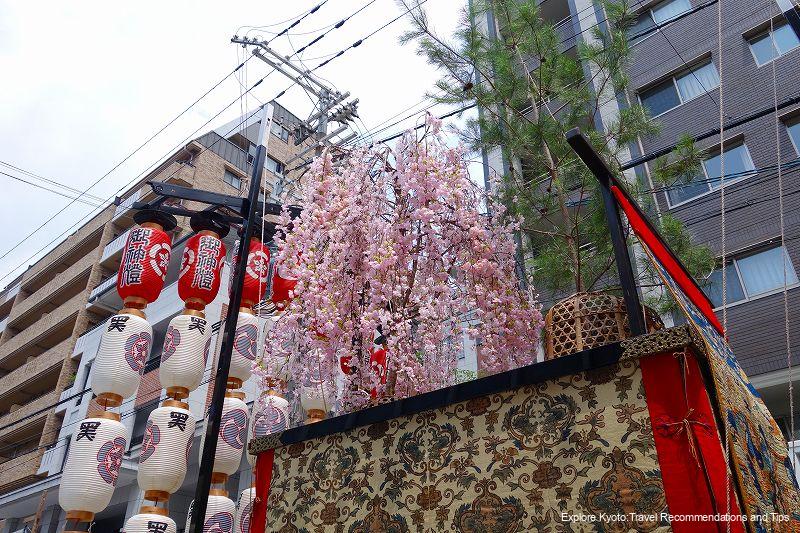
Though artificial, the cherry blossoms are quite beautiful. It is said that placing these artificial cherry blossoms or chimaki at the entrance of your home prevents misfortune from entering.
During the parade, a doll of Otomo no Kuronushi gazing at the cherry blossoms is displayed next to the flowers.
Origin of Kuroshiyama: The Noh Play “Shiga”
The noh play “Shiga,” which inspired the name Kuroshiyama, tells the following story:
A retainer serving the Emperor visits the cherry blossoms on Mount Shiga. There, he encounters two woodcutters, a young man and an old man, resting under the cherry blossoms.
The old man, with cherry branches on the firewood he was carrying, explains that although it may seem improper, they are resting in the shade of the cherry blossoms to honor a poem by Otomo no Kuronushi.
Praising the virtue of the poem, the old man reveals that he was once known as Kuronushi but has now become the deity of the mountain.
He then returns to Shiga Shrine. That night, the retainer sees Kuronushi appear as the deity of Shiga, dancing in the cherry blossom snowstorm.
Gion Matsuri Ato Matsuri: Kita Kannon-yama
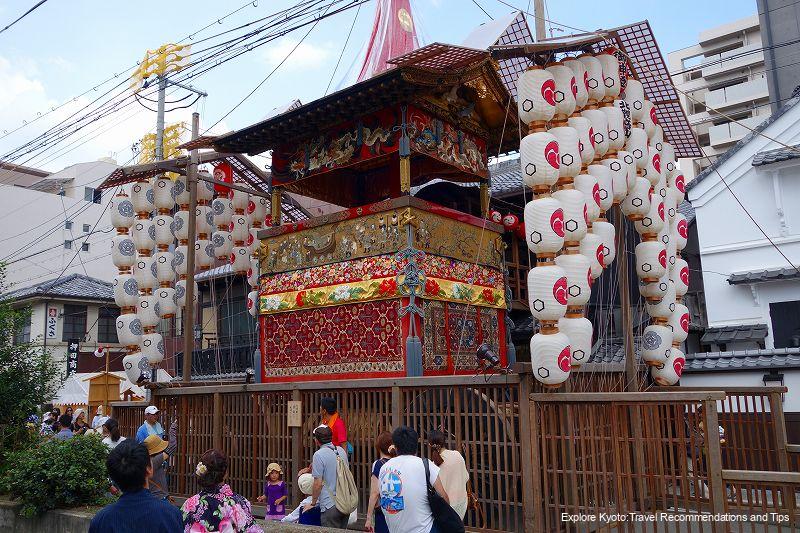
Shinmachi Rokkaku Shimoru, Kita Kannon-yama. Despite being called a “yama,” Kita Kannon-yama is essentially the same as a “hoko.”
Kita Kannon-yama, also known as “Nobori Kannon-yama,” has existed since before the Onin War. It is said that since that time, it alternates with the neighboring Minami Kannon-yama each year.
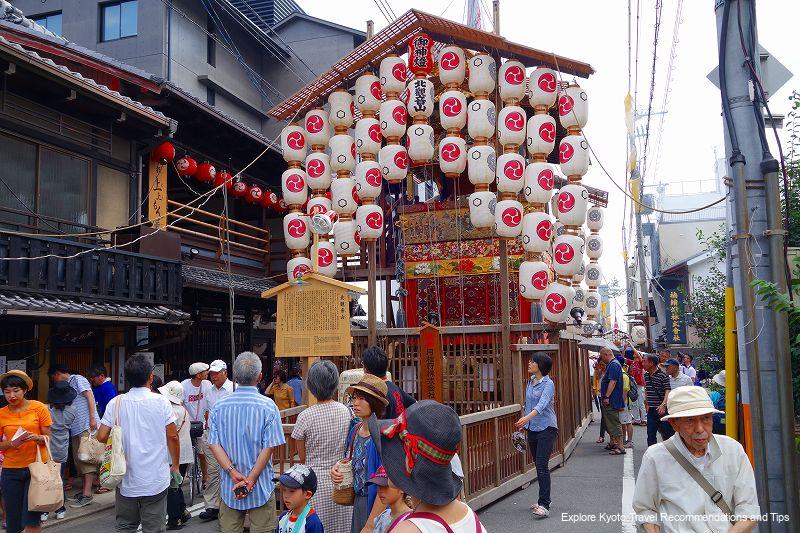
On top of the float, there are statues of Willow Kannon and Idaten. During the parade, the float carries a large willow branch in the rear, symbolizing Kannon’s act of saving people from suffering with a willow branch.
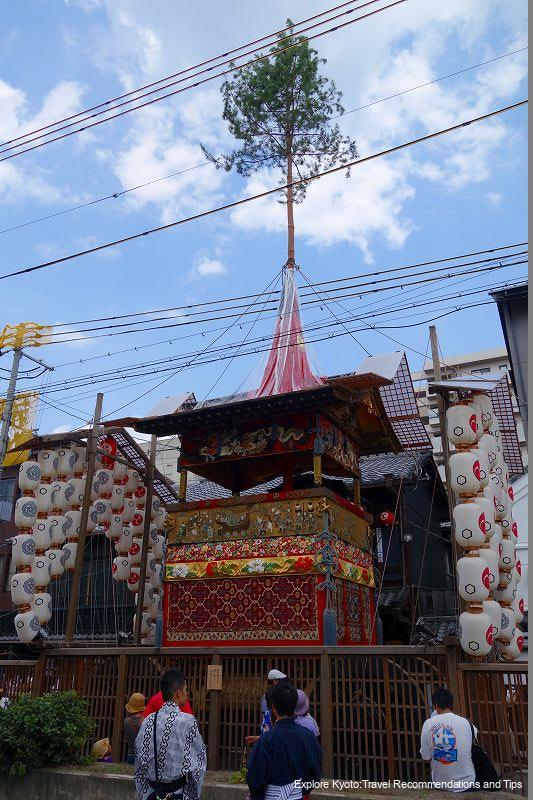
As Kita Kannon-yama is not a hoko, it has a pine tree instead of a sacred tree on the roof. As you can see, its height is comparable to the nearby Kyoto Central Post Office. A long-tailed bird is perched on the pine.
The decorations and hangings of Kita Kannon-yama
Because the neighborhood once housed wealthy merchants like Mitsui and Matsuzakaya, the decorations and hangings of Kita Kannon-yama are very luxurious.
The top hanging features a gold-ground brocade with Kannon arabesque patterns and cloud dragons, used alternately each year. The bottom hanging, featuring a design by Nakajima Raisho, depicts a procession of Chinese aristocrats and is made of gold-ground embroidery.
The rear hanging features a 17th-century Chinese Ming dynasty brocade with a design of children playing around a sun and phoenix.
The float’s body is adorned with 17th to 18th-century Indian flower carpets, while the front hanging is a 19th-century Middle Eastern medallion-patterned Persian carpet.
The body now features Turkmen carpets, and the rear hanging is a 19th-century Middle Eastern Persian carpet with floral patterns.
The old Kannon costume from 1651, a treasured item with a floral diamond pattern, is carefully preserved. The wooden carvings of cranes and clouds beneath the eaves, the decorative metal fittings on the corners, and the elegant metalwork on the rails enhance the splendor of Kita Kannon-yama.
Gion Matsuri Ato Matsuri: Minami Kannon-yama
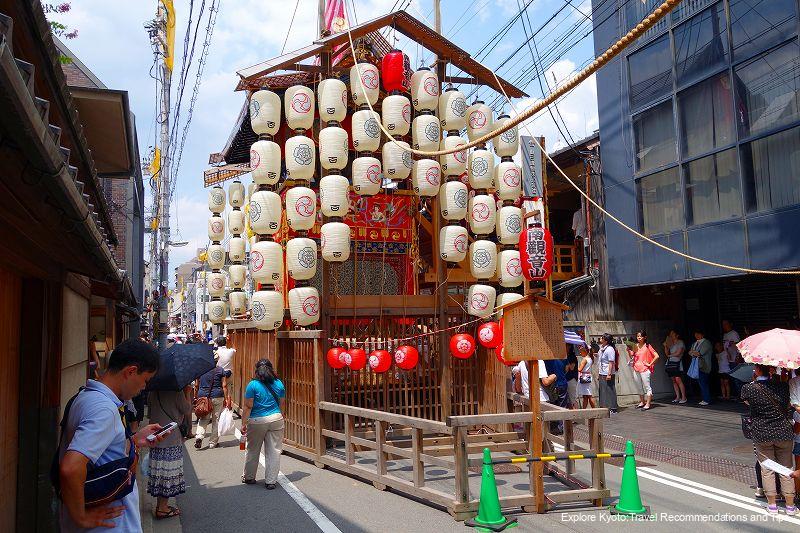
Shinmachi Takoyakushi Shimoru, Minami Kannon-yama. Known as “Kudari Kannon-yama,” it enshrines the Willow Kannon and the attendant deity Zenzai Doji.
Previously, it alternated each year with Kita Kannon-yama, but since the Meiji era, both floats parade every year.
Minami Kannon-yama, like Kita Kannon-yama and Iwato-yama, is a yama float but is similar to a hoko. However, as it is not a hoko, a pine tree is placed on the roof instead of a sacred tree.
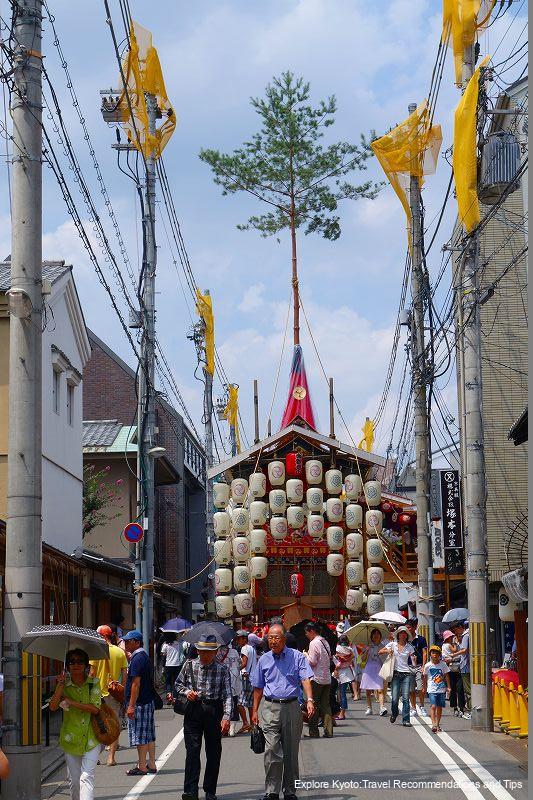
This pine tree is 15 meters tall and is installed manually without using heavy machinery.
The frame is tilted horizontally, the base of the pine tree is inserted, and then the frame is returned to its upright position. A pigeon sits on the second branch from the bottom.
Because it belongs to the same neighborhood as Kita Kannon-yama, Minami Kannon-yama’s decorations and hangings are equally luxurious.
The body hanging is a Persian floral tapestry, and the front hanging is a medallion-patterned Persian carpet. As seen in the image, the hangings are very vivid.
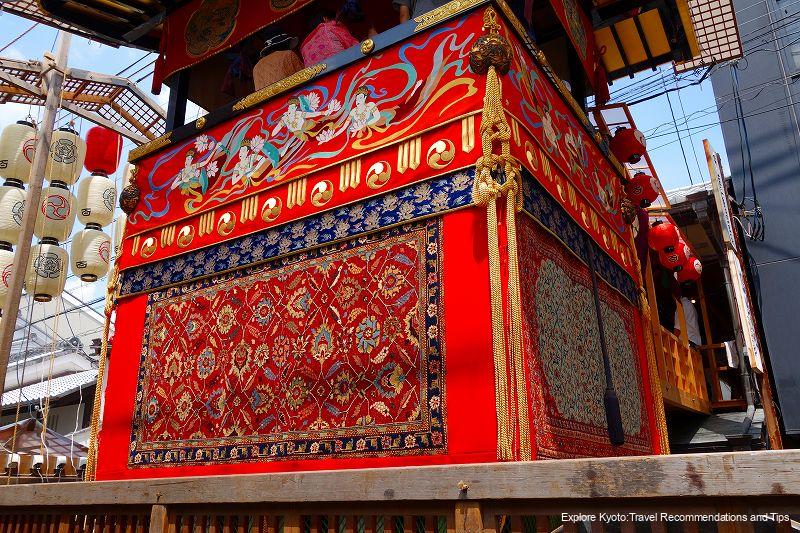
The top hanging was newly created in 2007, featuring a raised embroidery design of the Four Divine Beasts by Shiokawa Bunrin.
The bottom hanging was newly created in 1995, featuring the “Cloud Dragon Design” and “Heavenly Musicians” designed by Kayama Matazo.
The rear hanging, originally a Ming dynasty brocade with a wave pattern, was replaced in 1988 with the “Dragon King Crossing the Sea” design by Kayama Matazo.
The old front hanging from the 17th century is a beautiful Persian silk carpet known as “Ibru,” and other treasures like the oldest known Indian chintz from 1684 with floral designs are also preserved.
Abare Kannon: A unique night event in Minami Kannon-Yama
A unique event called “Abare Kannon” takes place late at night during Yoiyama, where the sacred statue of Willow Kannon is tied to a palanquin and violently shaken while being carried around the neighborhood. The origin and meaning of this mysterious ritual remain unclear.
I have written an article with a video of Abare Kannon. Please take a look if you are interested.
Abare kannon article: Abare Kannon: Minami Kannon Yama in Gion Matsuri
Gion Matsuri Ato Matsuri: First Night of Yoiyama
Now, it’s the first night of Yoiyama for the Gion Matsuri Ato Matsuri. The Ato Matsuri does not have street stalls, and since the first night of Yoiyama was the last day of the long weekend, the number of people out at night was significantly lower compared to the usual Yoiyama.
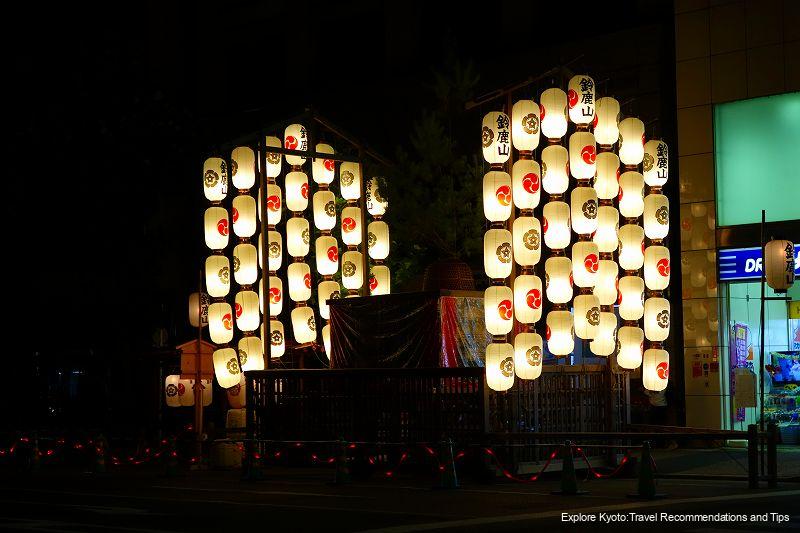
That aside, the lantern-lit floats at night create an ethereal and beautiful scene, as always. Here is Suzuka-yama.
At Shinmachi Sanjo Shimoru, Hachiman-yama during the day.
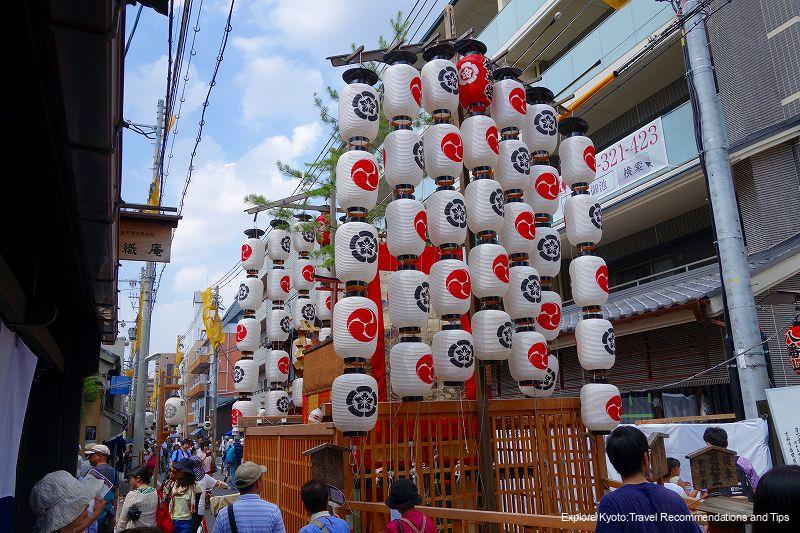
And here is Hachiman-yama at night. It has a different ambiance compared to its daytime appearance.
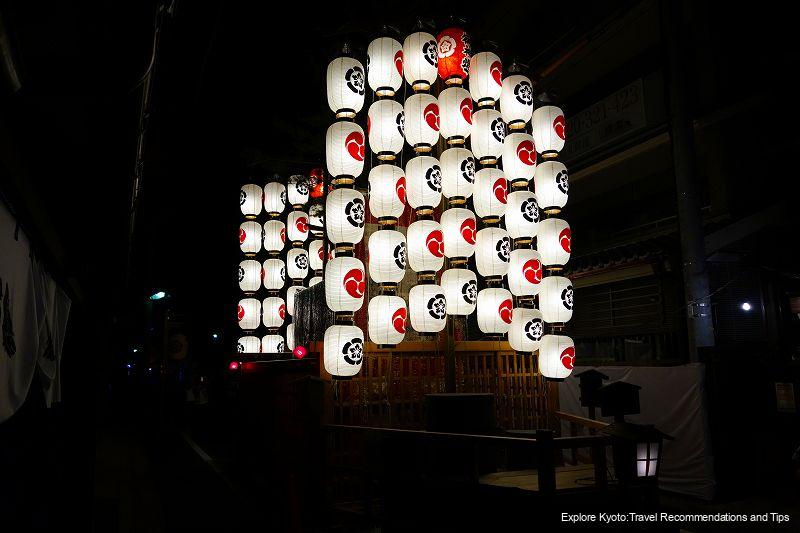
Shinmachi Takoyakushi Shimoru, Minami Kannon-yama at night. After 10 PM, the lanterns are turned off, and the floats take a brief rest.
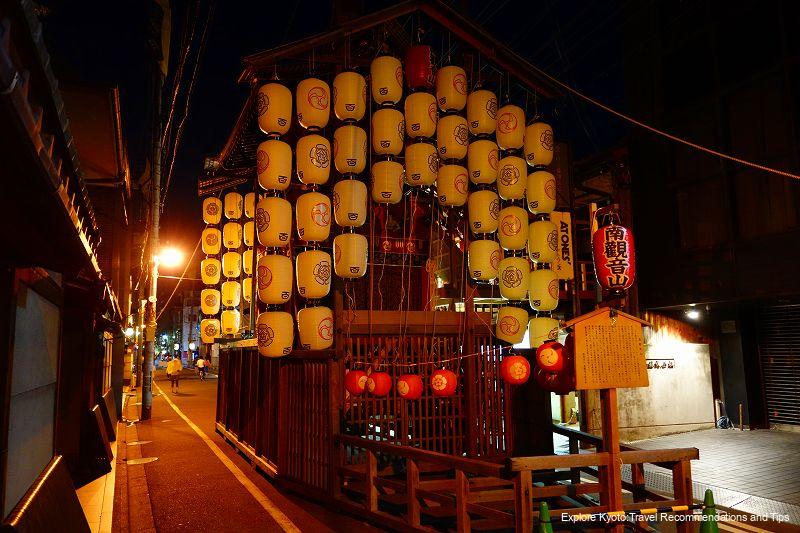
Even after the lanterns are turned off, the security personnel watch over Kita Kannon-yama throughout the night.
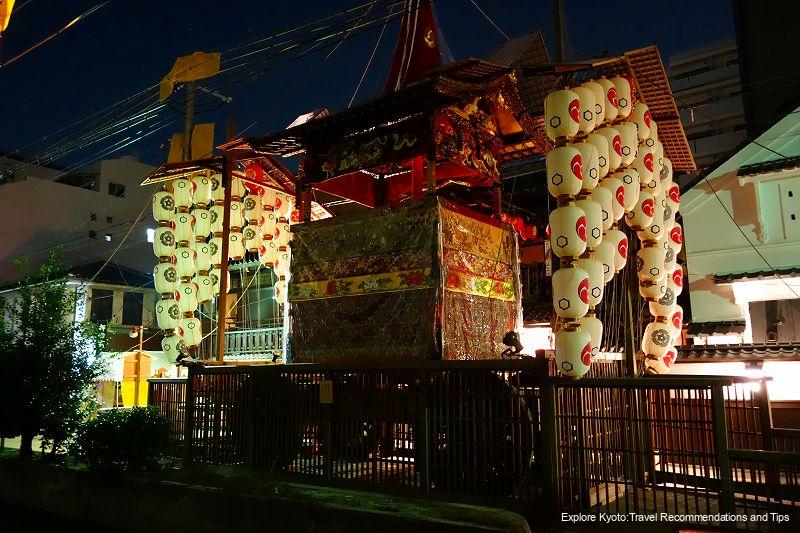
I’ve also written about the first night of Yoiyama for the Saki Matsuri. Please take a look if you are interested.
Saki Matsuri article: Gion Matsuri Saki Matsuri: Yoiyama
Japanese Article : 祇園祭 後祭宵山の様子
Comments Please feel free to post your comments!