

We will introduce the highlights, origins, and access methods of the ‘Abare Kannon.’
Abare Kannon at Minami Kannon Yama is held on the night of Yoiyama, the Atomatsuri of the Gion Matsuri (Second festival of the Gion Festival).
Minami Kannon Yama’s specialty, Abare Kannon, involves wrapping the goshintai, Yoryu Kannon, and Zenzai-doji (Sudhanakumâra) in cloth like mummies, tying the Yoryu Kannon to the base of the Mikoshi (portable shrine), and having a person carrying Zenzai-doji lead the procession through the town.
The Abare Kannon begins around 11:00 p.m., but despite the late hour, it is crowded with spectators.
Please be sure to see the video of Abare Kannon.
Abare Kannon at Minami Kannon Yama
Abare Kannon is held during Yoiyama (July 23), the Atomatsuri of the Gion Festival.
Even though it is late in the day, many spectators gather to catch a glimpse of the most unique event of the Gion Festival.

Abare Kannon arrives with a shout of “wasshoi.” The leader of the group is holding Zenzai-doji wrapped in a yellow cloth and carrying Yoryu Kannon on the Mikoshi.
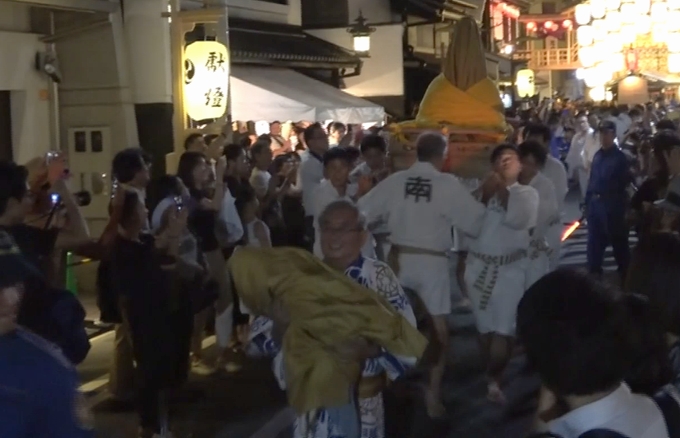
At Takoyakushi-dori, just before the Kita Kannon Yama, the Mikoshi is carried up with a vigorous shout of “wasshoi.”
In the old days, the Mikoshi did not turn back here, but went over the Kita Kannon Yama to Sanjo Street.

The mikoshi was smaller than expected, with only about 10 people carrying it.
The Yoryu Kannon is wrapped in cloth like a mummy. There seems to be no rule about the type of cloth or how to wrap it, and the cloth may differ from year to year.

Finally, the Mikoshi is carried up beside Minami-Kannon Mountain, and the Abare Kannon ends.
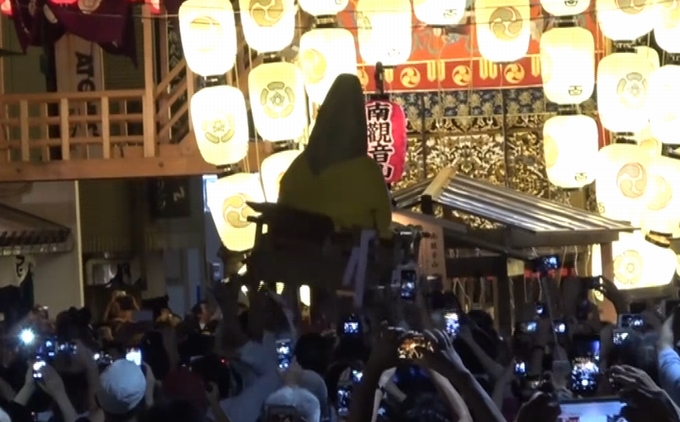
After the Abare Kannon, preparations for the Yamaboko procession begin immediately.
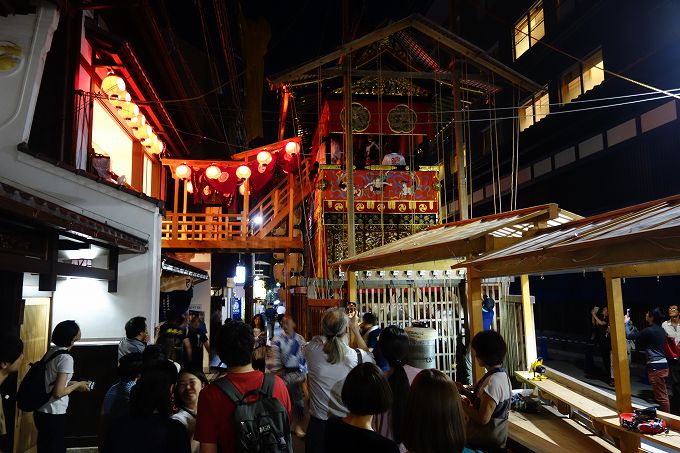
Komagata lanterns are dimmed, and the Yoryu Kannon and Zenzai-doji are displayed on Minami Kannon Yama in preparation for tomorrow’s Yamaboko procession.
The Origin of Abare Kannon
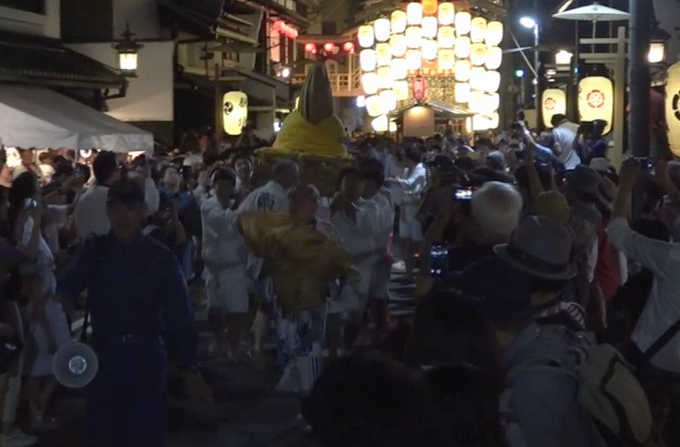
Abare Kannon starts around 23:00 on the night of Yoiyama, the 23rd of the Gion Festival.
It starts quite late because it is after the Hiyori Kagura, which prays for the safety of the Yamahoko-junko procession, returns.
Both the sacred Yoryu Kannon and the Zenzai-doji are wrapped in cloth. The Yoryu Kannon is carried tied to the base of the portable shrine, while the leader carries the Zenzai-doji back and forth through the town with shouts of “wasshoi.”
At the turnaround point and beside Minami Kannon Yama, the portable shrine of Yoryu Kannon is carried by swinging it up and down.
This is indeed a famous event of Minami Kannon Yama, and it seems as if the Kannon is on a rampage. It is a very mysterious event.
There are currently 34 Yamaboko floats in the Gion Festival, but only Minami Kannon Yama has an event like the Abare Kannon in Yoiyama, and its origin is not well known.
Both Kita-Kannon and Minami-Kannon enshrine the same Yoryu Kannon, but according to one theory, the same Yanagi Kannon has different genders, with Kita Kannon Yama being male and Minami Kannon Yama being female.
It is said that the origin of the Abare Kannon is that the female Kannon, who is in love with the male Kannon, is made to go on a rampage the night before the tour in order to calm her down and keep her quiet during the tour.
In the past, the Abare Kannon was performed by elderly people in the town during the Hiyori Kagura performance. However, due to a lack of manpower in the late 1960s, the Hayashi-kata (musicians) who returned from the Hiyori Kagura performance were put in charge of the Abare Kannon performance as well.
Minami Kannon Yama is supported by many behind-the-scenes people, including the musicians, the musical tradition, and the Minami Kannon Yama Preservation Society.
Abare Kannon: Starting time and Location
Abare Kannon starts at around 23:00 on July 23, the night of the Yoiyama of the Later Festival, and takes about 30 minutes.
It is quite late, so if you are taking a train or bus, please be careful not to miss your last ride.
Minami Kannon Yama is located in Mukadeya-cho, Nakagyo-ku, Kyoto City, along Shinmachi Dori. It is just between Takoyakushi Dori and Nishikikoji Dori. Abare Kannon takes place here.
The Abare Kannon is a Mikoshi that is carried three times between Takoyakushi Dori and Nishikikoji Dori from Minami Kannon Yama in the town of Mukadeya-cho, with a lively “wasshoi” at the north and south ends and beside the Minami Kannon Yama.
Access to Abare Kannon
To access Minami Kannon Yama, the Kyoto Subway Shijo Station or Hankyu railway Karasuma Station is convenient.
From Shijo Station, it is about a 6-minute walk to get Minami Kannon Yama.
The nearest bus stop is Shijo Karasuma. No parking is available, but coin-operated parking is available nearby.
However, please be aware that during the Gion Festival, the crowds are enormous, and walking access may take more than twice the usual time. During the Yoiyama of the Gion Festival, the surrounding areas are closed to traffic, so cars and parking lots are not available.
About Minami Kannon Yama: Gion Festival Atomatsuri
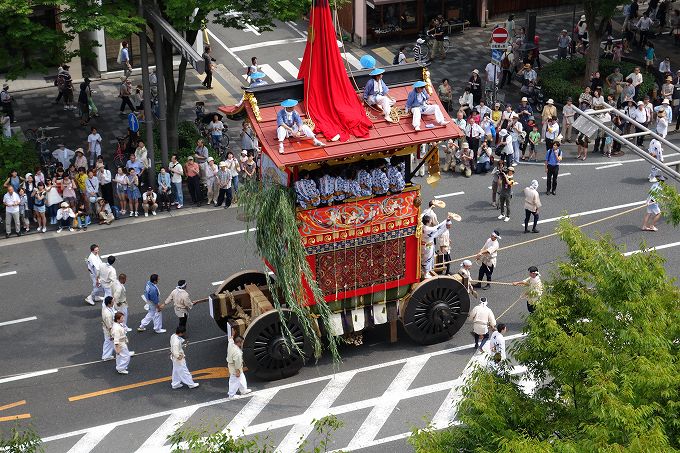
Previously, all the floats were paraded in one Gion Festival, but starting in 2014, for the first time in 49 years, the Sakimatsuri (first festival) and Atomatsuri (second festival) festivals were restored, and the parade was divided into two separate events.
The Minami Kannon Yama is paraded in the Atomatsuri.
Minami Kannon Yama is called “Shimo-Kannon-yama” and, like Kita Kannon yama, the “Kami-Kannon-yama” located on the north side of Shinmachi-dori, it is dedicated to Yoryu Kannon. Zenzai-Doji is also enshrined as a flanking deity.
Zenzai-Doji is held by a person in the Abare Kannon, and Yoryu Kannon is on a portable shrine.
During the Edo period, Minami Kannon Yama and Kita Kannon Yama alternated every other year, with those of , but since the Meiji period, both have appeared every year.
In the past, the Minami Kannon Yama was “Kujitorazu (drawing without a lottery for parade order),” and was always placed at the back of the procession, but after the Yamaboko procession was divided into the Sakimatsuri and Atomatsuri festivals, the role was given to the Ofunaboko.
Japanese Article : 祇園祭 南観音山のあばれ観音
Comments Please feel free to post your comments!